The Best Ophthalmology EMR Software for Seamless Days and Clearer Decisions
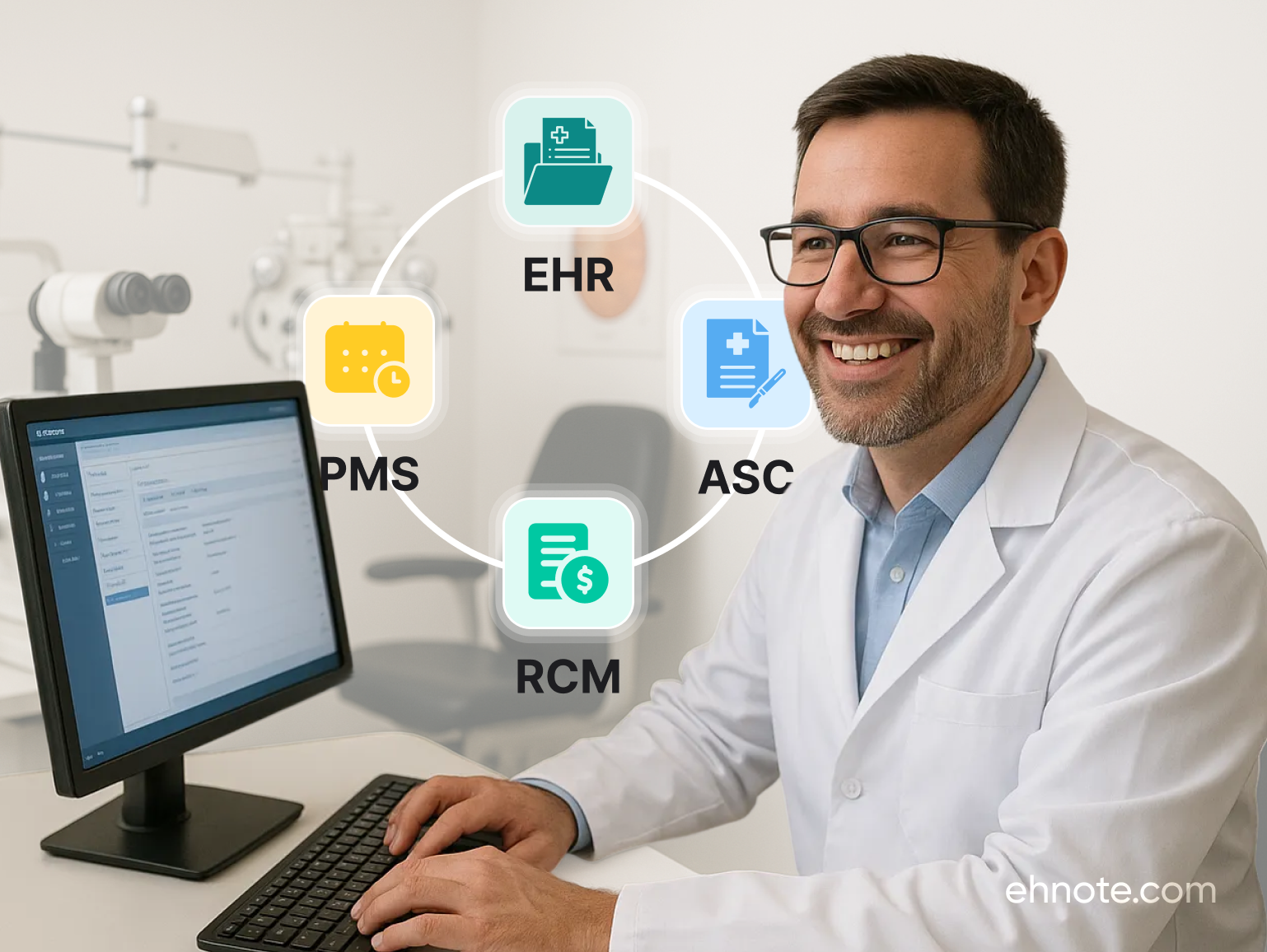
Every click, every extra field, every lag in your EMR is time stolen from patient care. Ophthalmology isn’t like any other specialty — your work depends on precision, speed, and clarity.
That’s why the best ophthalmology EMR isn’t just software — it’s a digital partner that thinks like you, moves at your pace, and simplifies everything from diagnosis to discharge.
Why ophthalmology needs a special EMR
Generic EHR/EMR software often fails to match what you do: visual exams, device-integrated diagnostics, intraocular lenses, surgery days, & billing precision.
- Traditional systems slow you down with non-specific templates or heavy admin work.
- Eye care demands seamless diagnostic integrations (OCT, fundus camera, visual‐field) and surgical workflows.
- Idle device data, disjointed workflows, and admin overhead cost you time — and thus patient care.
When the software matches your specialty, you free up time and brain-space to focus on your patients.
What a best-in-class ophthalmology system gives you
Here’s what you should expect — and what you’ll appreciate.
1. One unified platform
Rather than juggling separate EHR + PMS + Billing + ASC modules, the right system wraps everything together: clinic charting, surgery center, scheduling, billing, patient engagement. That means no vendor confusion, no integration puzzles.
2. Built for ophthalmology — not adapted
Templates for cataracts, glaucoma, retina; device-image imports; IOL inventory; injection/procedure management. The system “speaks your language”.
3. Faster workflows = more time for patients
Pre-built forms, auto-populated fields, device data auto-pull, voice-to‐text for charting. You spend less time documenting, more time diagnosing.
4. Less admin hassle
Fewer clicks, fewer transitions, fewer manual uploads. Fewer coding mistakes. Fewer rejected claims.
5. Better patient care
When the technology stays in the background, you’re more present with the patient. Data flows into the right place, you make faster decisions, you catch issues earlier.
6. Scalability & future-readiness
Whether you’re solo or multi-location, you want a system that grows with you, stays compliant (HIPAA, CPT/ICD, MIPS) and stays intuitive.
Top outcomes you’ll actualize
Here’s what this looks like in practice — the benefits you can measure.
- Save 12+ hours a week per provider (doctor + admin staff) — time you reclaim to see more patients or focus on quality.
- Charts at 90% point-of-care completion — your note is done while you’re with the patient, not later.
- Achieve up to 98% coding accuracy and 97% first-claim acceptance rate — fewer denied claims, smoother revenue.
- Get up to 30% lower cost than juggling multiple vendors, custom integrations, and legacy systems.
- See ROI within 4 months of implementation — the system pays for itself quickly.
These are real-world shifts, not hype.
How this impacts clinical workflows — step by step
Let’s walk through typical pain points and how the right EMR system fixes them:
1. Pre-visit & check-in
Instead of paper forms, manual entries and device reports floating around, the system presents you a patient summary with images, history comparisons, referral letters — all ready when the patient walks in.
2. Exam & diagnostics
You open the chart, see device scans imported (OCT, visual field, fundus). You draw on the image, annotate, select findings with one click. Your exam is structured for your subspecialty, no generic template forcing workarounds.
3. Decision-making & documentation
You complete your note via voice or click, auto-populate templates. The system suggests codes and checks potential issues (e.g., injection history, post-op alerts). Charts nearly done while you’re still with the patient.
4. Billing & revenue cycle
Your note, codes, superbill, and claim flow seamlessly. No gaps between documentation and billing. Fewer denied claims, smoother RCM.
5. Surgery/ASC workflows
From pre-op checklists to intra-op tracking to post-op summaries. Inventory and IOLs managed. You run your ASC administration with the same platform — no disconnect between clinic and surgical center.
6. Patient engagement & follow-up
Patients receive reminders, check-in digitally, view results on a branded app or portal. Your team manages recalls, engages proactively, not reactively.
Why choose this system for your eye practice
Because you deserve software that works with you, not against you. Because your specialty and workflows are unique — and generic tools don’t respect that. Because time saved is patient-time earned. Because better workflows mean better care.
If you’re looking for a unified, ophthalmology-built, intuitively designed system that covers EHR, ASC, PMS, Billing and Patient Engagement — and one that’s designed to save time and cost while elevating care — consider making the switch. Your practice, your patients, your care model will thank you.
Final thought
Your patients came to you for your expertise — not your data-entry speed. Give them all your focus. Let the system handle the rest. Switch to a platform that’s built for what you do. Streamline your workflows. Free your time. Strengthen your care. Because when the right software becomes invisible, you become unforgettable.


Comments
Post a Comment